
Decorative Acoustic Panels: Better Sound Without Sacrificing Design
- Aug 13
- 12 min read

Acoustic treatment does not have to make a room look like a recording studio.
Today, decorative acoustic panels can improve how a space sounds while becoming part of the interior design itself. Instead of choosing between acoustic performance and aesthetics, studios, offices, listening rooms, podcast spaces, and creative environments can integrate both.
But not every product labeled “acoustic” performs the same way.
Some decorative panels are designed primarily to look good. Others are engineered to control reflections, improve clarity, and solve real acoustic problems while still offering custom colors, artwork, graphics, and finishes.
The difference matters.
Whether you are treating a professional studio or improving an office conference room, the goal should be the same: choose acoustic treatment based on what the room needs, then make that treatment visually work within the space.
What Are Decorative Acoustic Panels?
Decorative acoustic panels are sound-absorbing panels designed to improve room acoustics while also contributing to the visual design of a space.
They can incorporate:
Custom fabrics
Different colors and textures
Printed artwork or photography
Brand graphics
Architectural patterns
Wood finishes
Custom sizes and shapes
Modular arrangements
Large-format visual designs
Their primary acoustic purpose is to absorb sound energy that would otherwise reflect from hard walls and ceilings.
When properly designed and positioned, decorative acoustic panels can help reduce excessive reflections, improve speech clarity, make recordings sound cleaner, and create a more comfortable listening environment.
The key is that they should still function as acoustic treatment first.
A panel should not be considered effective simply because it looks like an acoustic product.
Do Decorative Acoustic Panels Actually Work?
Yes. Properly designed decorative acoustic panels can make a significant difference in how a room sounds.
Their effectiveness depends on several factors:
The material inside the panel
Panel thickness
Panel placement
Surface area and coverage
Distance from the wall
The frequencies that need to be controlled
The dimensions and purpose of the room
A quality acoustic panel can help reduce:
Early reflections
Flutter echo
Excessive reverberation
Harshness
Poor speech intelligibility
Listening fatigue
Room coloration in recordings
Blurred stereo imaging
However, a thin decorative product may absorb primarily higher frequencies while leaving low-mid and bass problems almost unchanged.
That can create a room that sounds less bright without necessarily becoming more accurate.
For this reason, acoustic treatment should begin with the room—not with the product catalog.
Decorative Acoustic Panels vs. Standard Acoustic Panels
The main difference between decorative and standard acoustic panels is often how much flexibility they offer visually.
A traditional acoustic panel may consist of a rectangular absorber wrapped in a simple neutral fabric.
Decorative panels can use the same basic acoustic principles while incorporating:
Custom colors
Artwork
Photography
Branding
Architectural layouts
Different shapes
Large-format designs
When properly constructed, either type can provide effective absorption.
The mistake is assuming that a decorative panel must perform worse acoustically—or that every attractive wall panel advertised as acoustic will perform like professional treatment.
Performance comes from the acoustic construction.
The visual layer should complement that construction, not replace it.
Why Room Acoustics Matter
Sound does not travel directly from a voice, instrument, or speaker to your ears and stop.
It continues through the room and reflects from nearby surfaces such as:
Walls
Ceilings
Floors
Windows
Desks
Tables
Screens
Furniture
Those reflected sounds reach your ears slightly later than the original sound.
When reflections are excessive, they can make a space feel harsh, echoey, muddy, or difficult to understand.
In a recording studio, reflections can affect monitoring accuracy.
In a podcast room, they can make voices sound distant or overly “roomy.”
In a conference room, they can make conversations and video calls harder to understand.
In a listening room, they can blur stereo imaging and reduce detail.
Decorative acoustic panels allow these problems to be addressed without turning the space into a purely technical environment.
Where Decorative Acoustic Panels Work Best
Decorative panels can be used in many different environments.
The important part is choosing and positioning them according to how the space is used.
Recording Studios
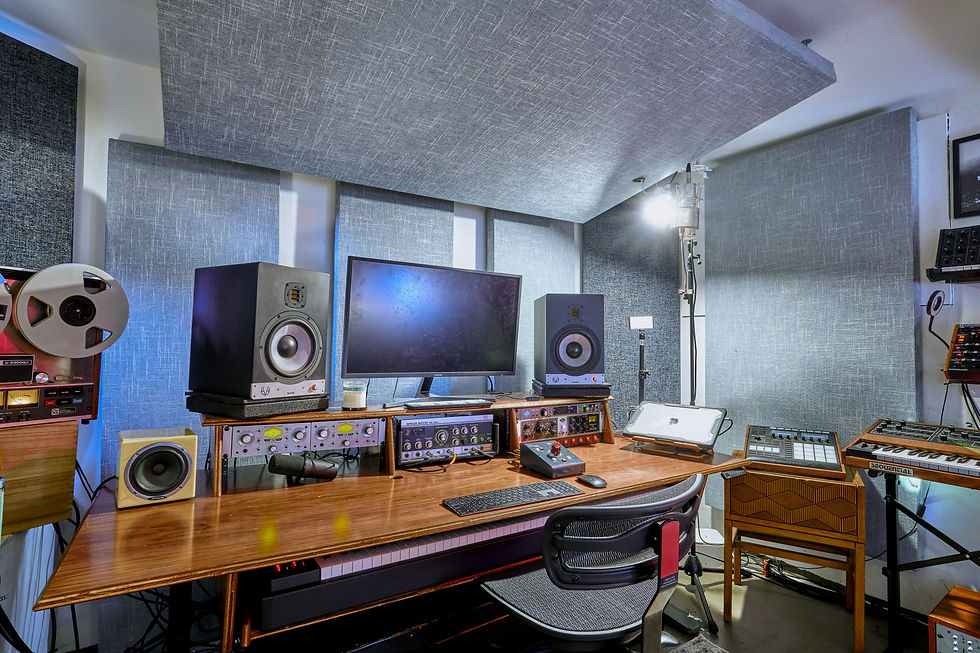
Recording studios need treatment in specific locations. Decorative acoustic panels can be incorporated at first reflection points, behind speakers, behind listening positions, and around recording areas.
This allows the studio to maintain a strong visual identity while still supporting accurate monitoring and cleaner recording. For artists, producers, and engineers, the room can become both a technical tool and an inspiring creative environment.
Home Studios
Home studios often occupy bedrooms, offices, garages, or spare rooms that need to remain visually connected to the rest of the home. Decorative panels make it possible to improve the room acoustically without making it feel temporary or overly industrial.
Artwork, colors, or custom fabric finishes can help treatment feel like part of the room rather than equipment added afterward.
Podcast and Content Creation Spaces
Voice recordings are particularly sensitive to room reflections. Hard walls, desks, windows, and ceilings can cause microphones to capture unwanted room sound alongside the voice.
Strategically placed acoustic panels can help make speech sound more direct, controlled, and professional. Printed or decorative panels are especially useful for video-based creators because they can also improve the visual background seen on camera.
Offices and Conference Rooms
Modern offices often use glass, hard floors, large tables, exposed ceilings, and minimal furniture. These surfaces can create excessive reverberation and poor speech intelligibility.
Acoustic panels can make meetings, calls, and conversations easier to understand while also becoming part of the office design or branding.
Listening and Media Rooms
Listening environments benefit from controlled reflections, but they also need to remain comfortable and visually appealing. Decorative acoustic panels can integrate treatment with lighting, furniture, artwork, and architectural finishes to create a room that feels intentional rather than technical.
Printed Acoustic Panels: Turning Treatment Into Artwork
One of the most flexible forms of decorative acoustic treatment is the printed acoustic panel.
Rather than hiding treatment or wrapping every panel in a plain fabric, printed panels allow artwork, photography, graphics, or branded designs to become part of the acoustic system.
Sense & Sound offers printed acoustic panels designed to combine large-format artwork with the acoustic performance required in serious listening and creative environments.
The printed covers are interchangeable, allowing the visual appearance of the panel to change without replacing the underlying acoustic treatment.
That means a room can evolve over time.
A studio can refresh its artwork. A company can update its branding. An artist can change the visual direction of a production room. A treatment system can potentially move into a new space without locking the owner into the same visual design.
Sense & Sound's printed acoustic panels are available in standard formats as well as large-scale sizes up to approximately 4 × 8 feet, allowing the treatment to function as a significant visual feature rather than something that needs to be hidden.
They also use removable mounting systems, helping the panels remain flexible while maintaining a clean, finished appearance.
Real-World Example: XYZ Films
The value of decorative acoustic treatment is not limited to recording studios.
XYZ Films provides a good example of how acoustic treatment can improve a professional environment where speech, communication, and visual design all matter.
Sense & Sound worked with XYZ Films to develop acoustic treatment for its office environment, addressing the sound of the space while creating panels that integrated visually into the room.
The result was not simply an office with acoustic panels attached to the walls.
The treatment was designed around the needs of the space.
The team at XYZ Films highlighted the combination of functionality and aesthetics, along with the noticeable improvement in the office environment—particularly for conference calls and everyday communication.
That is an important distinction.
An office does not need to be a recording studio to have acoustic problems.
Conference rooms and creative workspaces often contain reflective surfaces such as glass, drywall, tables, screens, and hard flooring. Voices bounce between these surfaces, increasing reverberation and reducing clarity.
By using acoustic treatment that also works visually within the room, the acoustic solution becomes part of the interior design rather than something that needs to be concealed.
Where Should Decorative Acoustic Panels Be Placed?
Where the panel goes is often just as important as which panel you choose.
Random placement may make a room somewhat less reflective, but strategic placement can achieve a much stronger result.
First Reflection Points
In studios and listening environments, first reflection points are usually high-priority treatment locations.
These are areas where sound from the speakers reflects from the side walls or ceiling before reaching the listening position.
Controlling these reflections can improve:
Stereo imaging
Clarity
Detail
Depth perception
Monitoring accuracy
Behind the Listening Position
The rear wall can produce strong reflections that return toward the listener.
Depending on the size and geometry of the room, this area may benefit from absorption, diffusion, or a combination of both.
Ceiling Areas
Reflections also occur vertically. A ceiling cloud or suspended acoustic treatment can reduce reflections above a listening, recording, meeting, or conference area.
In many rooms, ceiling panels can also become an important architectural design feature.
Recording Positions
For vocals, podcasts, voiceover, or instruments, treatment should be placed according to the relationship between the performer, microphone, and reflective surfaces.
Simply putting one small panel behind the microphone is not always enough.
The objective is to control the reflections that are most likely to reach the microphone.
How Thick Should Decorative Acoustic Panels Be?
Panel thickness affects what frequencies the treatment can absorb effectively.
Very thin absorbers primarily affect higher frequencies.
Thicker acoustic panels can generally absorb farther into the mid and lower frequency ranges.
That means panel thickness should be selected according to the problem being addressed.
An office primarily concerned with speech intelligibility may have different acoustic requirements from a professional mix room where accurate low-mid information matters.
This is one reason extremely thin decorative acoustic products should be evaluated carefully.
They may reduce obvious echo while leaving deeper acoustic problems unresolved.
For professional audio rooms, treatment needs to address more than what is immediately noticeable to the ear.
What About Bass?
Bass is one of the most difficult parts of a room to control. Low frequencies have long wavelengths and behave differently from high-frequency reflections.
A few decorative wall panels will usually not solve major low-frequency issues on their own.
Recording studios, production spaces, and critical listening environments may also require:
Bass traps
Thicker broadband absorbers
Corner treatment
Rear-wall treatment
Front-wall treatment
Careful speaker placement
Listening-position adjustment
Measurement and calibration
Decorative acoustic panels can be an important part of the solution, but they are still part of a larger acoustic system.
A room can look thoroughly treated and still provide inaccurate bass information.
Decorative Acoustic Panels Are Not Soundproofing
Acoustic treatment and soundproofing are often confused. They solve different problems. Acoustic treatment controls the sound inside a room.
It reduces reflections, reverberation, and other problems that affect clarity.
Soundproofing, more accurately called sound isolation, reduces the amount of sound that travels into or out of the room.
Decorative acoustic panels can make a room sound significantly better inside, but they will not prevent loud music from reaching a neighboring room or stop traffic noise from entering.
Sound isolation usually requires construction involving:
Additional mass
Airtight seals
Decoupled walls
Specialized doors
Window systems
Floor and ceiling assemblies
Quiet HVAC
Properly sealed penetrations
If the room sounds echoey or unclear, acoustic treatment may be the answer.
If the problem is sound traveling between rooms, a sound isolation strategy is needed.
Printed Acoustic Panels vs. Panels That Only Look Acoustic
When shopping for decorative acoustic panels, it is worth looking beyond appearance.
Some products are acoustic absorbers with a decorative finish.
Others are decorative wall products that provide limited acoustic performance.
Before selecting a panel, ask:
What material is inside it?
What frequencies is the panel designed to absorb?
How thick is it?
Is the decorative surface acoustically transparent?
Is acoustic performance data available?
Can it be mounted with an air gap?
Is it suitable for critical audio environments?
Is the treatment designed around the room or simply sold as a wall accessory?
This matters especially in recording studios, mixing rooms, and other environments where inaccurate acoustics can affect creative decisions.
The ideal decorative panel should accomplish both goals:
Improve the way the room sounds and improve the way the room looks.
Fabric-Wrapped vs. Wood Decorative Acoustic Panels
Decorative acoustic panels can take several forms.
Fabric-Wrapped Acoustic Panels
Fabric-wrapped panels usually contain an absorptive core inside a frame.
They offer significant visual flexibility because the fabric, color, size, and shape can be customized.
Printed fabric can also transform the panel into artwork or branded design.
These panels are commonly used in:
Recording studios
Home studios
Offices
Conference rooms
Podcast spaces
Listening rooms
Creative facilities
Wood Acoustic Panels
Wood treatments can provide a warmer architectural appearance. Some designs combine wood slats or perforated surfaces with acoustic material behind them.
Depending on their construction, these systems may offer absorption, scattering, diffusion, or a combination of acoustic effects. However, a decorative wooden surface does not automatically make something acoustic.
A solid wall panel with no effective acoustic system behind it may simply reflect sound.
How to Choose Decorative Acoustic Panels
The best acoustic panel is not necessarily the one that looks best in isolation.
Start with the room.
Consider:
Room dimensions
Purpose of the space
Wall construction
Ceiling height
Amount of glass
Floor materials
Speaker placement
Listening position
Microphone placement
Existing furniture
Current acoustic problems
Visual design
Available treatment locations
Then evaluate the product.
Useful questions include:
What problem will this panel solve?
What range of frequencies does it absorb?
Is it thick enough for the intended application?
Is the covering acoustically suitable?
Can the size or artwork be customized?
Does it have documented acoustic performance?
Can it integrate with other treatment?
Does it fit the long-term design of the space?
The process should not begin with “How many panels can we fit on this wall?”
It should begin with “What is this room doing to the sound?”
The Problem With Choosing Treatment by Appearance Alone
A room can look professionally treated and still sound unreliable.
This happens when panels are selected and positioned as decoration rather than acoustic treatment.
For example, a studio may have perfectly symmetrical artwork on its walls while the actual first reflection points remain untreated. Another room may contain a large amount of thin absorption but no meaningful low-frequency control.
The room looks finished, but the important acoustic problems remain.
The opposite problem can also happen.
A room may perform well acoustically but look visually inconsistent because treatment was added one panel at a time without an overall design plan.
The strongest spaces solve both problems together.
Buying Panels vs. Designing an Acoustic System
A collection of good acoustic panels does not automatically create a good room.
For critical listening or recording spaces, acoustic treatment should be considered alongside:
Room geometry
Speaker placement
Listening position
Bass control
Furniture
Recording positions
Isolation
Workflow
Calibration
This is the difference between simply buying acoustic panels and designing an acoustic system.
At Sense & Sound, this broader approach is central to how studio environments are created. The question is not just which panels should go on the wall.
The more useful question is:
What does this room need in order to become a space you can trust?
The answer may involve acoustic panels.
It may also involve moving the speakers, repositioning the listening area, adding bass control, adjusting furniture, measuring the room, or changing another part of the system.
Are Decorative Acoustic Panels Worth It?
For spaces where both acoustics and visual design matter, decorative acoustic panels can be a worthwhile investment.
They can improve:
Speech clarity
Recording quality
Listening accuracy
Comfort
Interior design
Professional appearance
Client experience
Creative focus
For recording and production spaces, better acoustics can also reduce second-guessing.
If the room provides more reliable information, engineers and creators can make decisions faster and spend less time checking their work elsewhere.
For offices, conference rooms, and content environments, improved acoustic control can make communication clearer and reduce the fatigue associated with highly reflective rooms.
The greatest value comes from using decorative panels as part of a properly designed acoustic solution.
Frequently Asked Questions About Decorative Acoustic Panels
Do decorative acoustic panels reduce echo?
Yes. Absorptive acoustic panels can reduce reflections and reverberation, which are often perceived as echo.
How much improvement they provide depends on panel performance, placement, room dimensions, and the amount of treatment used.
Can decorative acoustic panels soundproof a room?
No.
Acoustic panels improve the sound inside a room. Soundproofing requires construction designed to limit sound transmission between spaces.
Can acoustic panels have custom artwork?
Yes.
Printed acoustic panels can incorporate photography, graphics, branding, artwork, or other visual designs while maintaining acoustic functionality when the system is properly constructed.
Where should decorative acoustic panels be installed?
Common locations include first reflection points, rear walls, recording areas, conference room walls, and ceilings.
The ideal location depends on the room and how it is used.
Are thicker acoustic panels better?
Thicker panels generally provide useful absorption farther into the lower-frequency range than very thin panels. However, the right thickness depends on the acoustic problem being solved.
Do rugs and furniture replace acoustic panels?
No. Rugs, curtains, sofas, and other soft materials can reduce some high-frequency reflections, but they do not provide the predictable broadband control available from purpose-designed acoustic treatment.
Can I replace the artwork on a printed acoustic panel?
With systems such as Sense & Sound's printed acoustic panels, interchangeable printed covers allow the visual design to be updated without replacing the underlying acoustic panel.
Final Thoughts
Decorative acoustic panels make it possible to improve a room's sound without treating aesthetics as an afterthought. But the strongest results come when acoustics and visual design are planned together.
The goal should not simply be to fill empty walls with attractive panels.
It should be to understand what the room is doing to sound, determine where treatment will have the greatest impact, and choose solutions that support both acoustic performance and the character of the space.
Sense & Sound's printed acoustic panels demonstrate how treatment can become large-format artwork while still serving an acoustic purpose. Projects such as XYZ Films also show that this approach extends well beyond traditional recording studios into offices, conference rooms, and other creative environments.
Whether the room is used for recording, mixing, listening, meetings, podcasting, or content creation, the principle remains the same:
Design the acoustic treatment around the room—not simply around the empty wall space.
When acoustics and aesthetics work as one system, the result is a space that looks intentional, sounds controlled, and works better for the people inside it.


Comments